
Beijing Yunyu Technology Co., Ltd.
I. Client Introduction
Beijing Yunyu Technology Co., Ltd. is committed to providing enterprises with advanced digital transformation solutions. Focusing on cloud computing, big data analysis and artificial intelligence technologies, it customizes efficient and reliable systems and services for clients, helping them maintain a competitive edge in the rapidly changing market.
Its team consists of experienced engineers and industry experts, with profound technical strength and rich project experience. Adhering to a customer-centric philosophy, it provides full-cycle services from consulting and planning, technical implementation to post-maintenance, ensuring clients achieve optimal return on investment (ROI).
Believing that technological innovation can drive social progress, the company will continue to invest in R&D, continuously improve its technical capabilities, and create more value for clients.
II. Project Objectives
With the continuous expansion of the e-commerce platform’s user scale and business volume, the original system architecture faces high concurrent access pressure and data processing bottlenecks during promotion peaks. Risks of slow website response and even service interruption have increased significantly, seriously affecting user shopping experience and order conversion rate. Meanwhile, insufficient system scalability and long cycles for function iteration and version release restrict business agility and market response speed.
To support the platform’s long-term stable development, it is necessary to build a cloud-native architecture with high availability, strong security and easy scalability. The e-commerce platform is rebuilt based on Oracle Cloud Infrastructure (OCI), aiming to achieve dual improvements in system stability and elasticity. Through multi-availability zone deployment and auto-scaling, single points of failure are eliminated and business continuity is guaranteed. Additionally, OCI’s native security services are leveraged to strengthen overall protection.
III. Architecture Design
AI Capabilities
- On the OCI Data Science platform, Natural Language Processing (NLP) models are built and run for intelligent document classification, key information extraction, and automatic summary generation.
- Generative AI is integrated to support large model applications, facilitating better data analysis.
- OCI high-performance computing instances are utilized for data processing.
Architecture Access
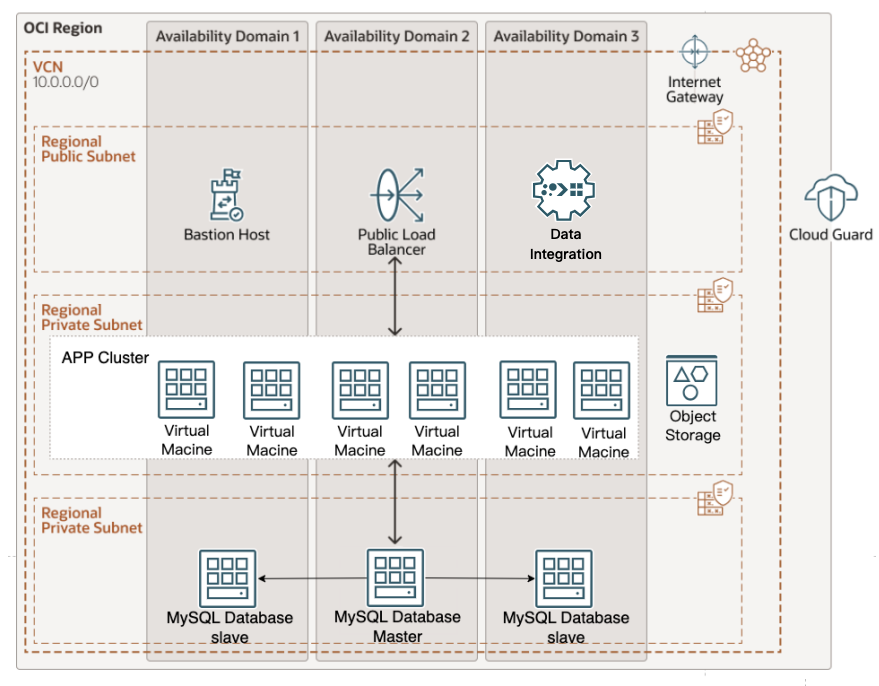
- External users access the public load balancer via domain names, and then connect to the application cluster deployed in private subnets (application layer).
- Internal operation and maintenance must be conducted through bastion hosts in public subnets to ensure security.
High-Availability Design
The data layer uses Oracle Cloud’s native database service, MySQL Heatwave, deployed in independent private subnets. This service not only provides a high-availability architecture by default, automatically handling failover to ensure database reliability, but also integrates Online Transaction Processing (OLTP) and Online Analytical Processing (OLAP) capabilities. This unifies transaction and analysis processing, greatly enhancing the real-time performance of data-driven decision-making.原生数据库服务 MySQL Heatwave,部署于独立的专用子网。该服务不仅默认提供高可用架构,自动处理故障切换,确保数据库服务的高可用性。其核心价值更在于深度融合了在线事务处理与分析处理能力。实现了事务与分析的统一处理,极大提升了数据驱动决策的实时性。
The application layer adopts a cluster of multiple virtual machines to form a stateless or horizontally scalable architecture. Combined with the load balancer’s health checks and traffic distribution, seamless failover and auto-scaling are achieved.
IV. Project Process
1. Requirements Analysis and Strategic Planning
- Conduct in-depth analysis of the existing research system’s workflows, data assets, and technical services.
- Collaborate with various research teams to clarify core needs such as intelligent classification, knowledge retrieval, and collaborative analysis.
- Based on OCI’s service capabilities, develop a detailed future architecture blueprint and migration roadmap.
- Select partial functions as proof-of-concept (PoC) scenarios to verify the end-to-end technical path and business benefits from data access to service integration.
2. Infrastructure Setup
- Use Infrastructure as Code (IaC) tools to automatically create and configure basic cloud environments, including VCN, subnets, security policies, and Identity and Access Management (IAM).
- Deploy core network and security components such as bastion hosts and load balancers.
- Securely migrate historical research data to OCI Object Storage. Meanwhile, establish a structured data warehouse in MySQL Heatwave and complete initial data cleaning and labeling.
3. AI Capability Building
- Conduct training, evaluation, and optimization of core AI models on the OCI Data Science platform.
- Integrate OCI Generative AI services to build a research assistant prototype for auxiliary content generation and intelligent Q&A.
4. Testing, Optimization, and Continuous Operations
- Complete full integration of AI services and cloud databases.
- Conduct large-scale concurrent user access testing, data processing pipeline stress testing, and failover drills to ensure system performance, scalability, and stability meet design requirements.
- Formulate detailed release and rollback plans: first guide partial research teams to pilot use, then gradually complete the full migration of all users and data.
- Provide comprehensive technical training for operation and maintenance as well as R&D teams, and hand over automated operation and maintenance scripts, monitoring dashboards, and cost management tools.
V. Value of Cloud Migration
- OCI’s powerful cloud-based AI platform has improved the automated processing and analysis capabilities of research data by over 50%. Researchers are freed from tedious information screening, allowing them to focus on high-value insight discovery and strategic analysis, shortening the innovation conversion cycle by approximately 40%.
- Completely eliminated the challenges of hardware procurement cycles and capacity planning. Computing resources required for research are available on-demand in seconds and automatically released after task completion, reducing the Total Cost of Ownership (TCO) of high-performance computing by over 35%. Additionally, MySQL Heatwave’s integrated analysis capabilities eliminate the need for independent data warehouse construction and maintenance costs.
- Based on OCI’s native high-availability architecture (such as application clusters and Heatwave’s automatic failover) and network defense security model, system availability reaches over 99.95%, providing enterprise-level security protection and compliance assurance for the company’s core knowledge assets.
VI. Client Achievements
- Intelligent Upgrade of Core Research Business: The new-generation intelligent research platform has become a daily standard tool for all the company’s research teams. The number of supported research projects and the quality of outputs have increased by over 50% year-on-year, significantly enhancing the company’s insight and influence in professional fields.
- Agile Innovation: The flexible and open cloud-based architecture enables the company to maintain continuous technical agility and quickly transform the latest technologies into client value.
- Increased Research Output: The depth and breadth of research reports have been highly recognized by clients. The quarterly output of high-quality research reports has increased by 50%, providing stronger support for solution design.
- Team Capability Upgrade: During the project, research and R&D teams have fully mastered the complete set of skills for cloud-native AI development and operation and maintenance, cultivating an interdisciplinary talent team.