
EASY TECH GROUP CO., LIMITED
I. Client Introduction
EASY TECH GROUP CO., LIMITED is a one-stop software service platform dedicated to serving Chinese enterprises going global. Centered on customer needs, the company breaks the limitations of a single software vendor by acting as an agent for multiple categories of software products. From a neutral perspective, it tailors the most suitable software portfolio solutions for enterprises.
Its core service model starts with in-depth business consulting, aiming to fully understand customers’ development goals and challenges, and then provides targeted software selection and efficient, secure implementation services. This consulting-driven and implementation-guaranteed model ensures that software services closely align with enterprises’ actual businesses, ultimately helping overseas-going enterprises reduce costs, improve efficiency, and achieve a win-win situation for both parties.
II. Project Objectives
The client’s core advertising system processes tens of billions of ad requests daily, with a data throughput reaching the terabyte level. With the rapid business development in Europe, America, Southeast Asia and other regions, the original domestic system can no longer meet the needs of overseas customers. Now, the plan is to deploy the system overseas to support overseas business operations.
To ensure the client’s sustained competitiveness in the global digital advertising market, it is necessary to build a more flexible, highly available, high-performance and cost-effective next-generation advertising technology architecture. Oracle Cloud Infrastructure (OCI) and managed services will be used to provide a stable and sound operating environment for the advertising system.
III. Architecture Design
Global Access and Scheduling Layer
- Leverage OCI’s global backbone network and DNS traffic management to intelligently route global user requests to the nearest edge nodes.
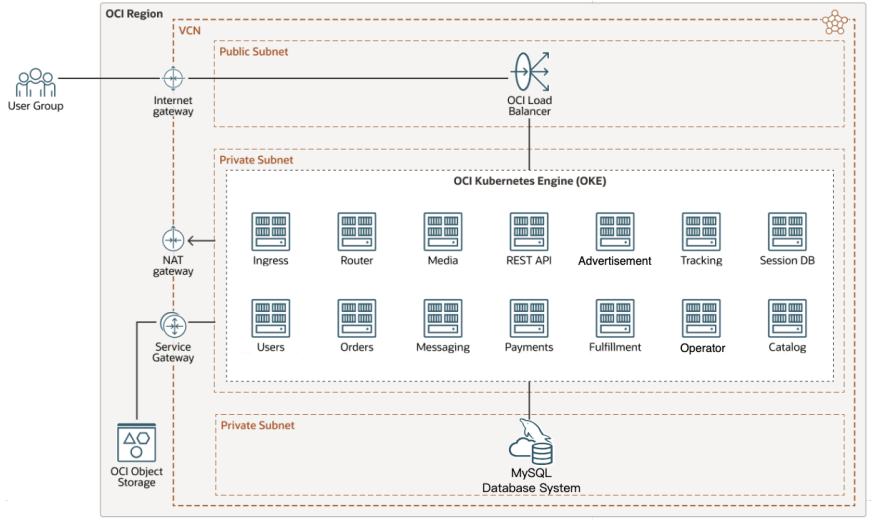
- The front end adopts an OCI Load Balancer cluster to intelligently distribute massive user requests from the Internet to the back-end application layer, which is connected to server clusters deployed in multiple Availability Domains (ADs) to ensure that a single computer room failure does not affect services.
High-Performance Computing Layer
- Core servers use OCI high-performance computing instances to ensure high network throughput and low-latency NVMe local storage performance.
- Through OCI Auto Scaling policies, the number of instances is dynamically adjusted based on real-time QPS and CPU utilization.
- All stateless services are containerized and deployed in OCI Kubernetes Engine (OKE) to improve deployment consistency and management efficiency.
Real-Time and Batch Processing Data Layer
- Client logs are collected through API Gateway and written to OCI Streaming service in real time. All raw logs are ultimately backed up to OCI Object Storage.
- Processed structured data is loaded into OCI Autonomous Data Warehouse, which supports all scenarios from real-time queries to complex analysis through its automatic indexing, auto-scaling and built-in machine learning capabilities, improving report generation efficiency.
Security and Management Layer
- At the network level, OCI Virtual Cloud Network (VCN) is used for strict isolation with clear subnet division.
- Implement least-privilege access control through security lists and network security groups.
- Deploy OCI Web Application Firewall (WAF) at the application layer to defend against common web attacks.
- All operation logs and API call logs are collected into OCI Logging service, with key alerts set up.
IV. Project Process
1. In-Depth Assessment and Design
- Form a joint project team with the client to conduct detailed discovery work, including asset inventory, dependency mapping, and performance baseline testing.
- Based on the assessment results, jointly design and review the detailed target architecture, migration strategy, and complete rollback plan.
2. OCI Environment Construction and Pilot Migration
- Build a mirror image of the production environment on OCI, including network topology and Identity and Access Management (IAM) policies.
- Prioritize migrating relatively independent data backup and offline analysis tasks to verify data integrity and performance.
3. Phased Production Migration and Switching
- Migrate applications in multiple batches: First migrate offline or non-core systems such as log processing and data analysis; build and verify new data pipelines on the target cloud, migrate and deploy supporting microservices; adopt a “dual-running” mode to replicate production traffic to the new environment for full business verification, ensuring complete matching of functions and performance.
- Start switching core business traffic: Use load balancer configuration to gray-scale import a small amount of real traffic into the new environment and monitor closely. Then gradually increase the traffic ratio until 100% switching is completed, and the entire process can be rolled back quickly.
4. Optimization, Governance and Knowledge Transfer
- Conduct intensive monitoring and performance tuning of customer resources; use OCI Cost Management tools to analyze expenditures and adjust resource specifications and reservation strategies.
- Deliver a complete set of architecture documents and operation and maintenance manuals, and carry out operation and maintenance training to ensure that the customer’s team can independently manage the new environment.
V. Value of Cloud Migration
OCI has brought comprehensive and measurable advantages to the client:
- Obtained a high-performance, highly available global technical foundation. The reduction in bidding latency directly enhances platform competitiveness; the modernization of the data platform turns data into real-time assets, empowering business intelligence.
- Through OCI’s flexible billing model and the automated management of Autonomous Database, the total cost of ownership (TCO) has been significantly reduced. The computing resource utilization rate has increased from less than 30% to over 65%, achieving true cost-effectiveness optimization.
- The elasticity of the system has enhanced the client’s ability to cope with traffic peaks during large-scale marketing campaigns, ensuring revenue stability. Faster report delivery speed has improved internal operations and customer decision-making efficiency.
VI. Client Achievements
- Performance Indicators: Core business latency has been significantly reduced, and data processing speed has been accelerated.
- Availability and Elasticity: The overall platform availability has been improved to 99.95%. The system can automatically scale to 300% of its original capacity within 5 minutes to cope with sudden traffic.
- Cost-Effectiveness: After three months of optimization, the monthly total infrastructure cost has been reduced by an average of 25% compared with the previous business cost.
- Operational Efficiency: Database management workload has been reduced by approximately 50%, allowing the data team to be freed from tedious operation and maintenance work and focus on data models and business analysis.
- Customer Feedback: “This cooperation with OCI is not only a successful technical migration but also a key upgrade of our platform. The performance and cost advantages of the new architecture have given us a more solid foothold in the fierce international market and opened up new space for our product roadmap.”