
Guizhou Jieba Cloud Technology Co., Ltd.
I. Client Introduction
Guizhou Jieba Cloud Technology Co., Ltd. is a full-link solution provider with years of in-depth experience in the cross-border e-commerce sector.
With “data-driven cross-border growth” as its core, the company relies on its independently developed intelligent analysis platform to provide core services for enterprises expanding into North America, Europe and ASEAN markets:
- In-depth market insights based on multi-dimensional data modeling, which enables real-time analysis of consumer behavior, competitive landscape and policy trends in target regions.
- An intelligent product selection system built with machine learning algorithms, realizing seamless connection between dynamic optimization of production plans and market demand forecasting.
Guizhou Jieba Cloud Technology Co., Ltd. is committed to helping clients build a complete closed loop from market research and product positioning to flexible supply, assisting enterprises in reducing costs, improving efficiency, and accurately completing their global layout.
II. Project Objectives
With the continuous expansion of the user scale and business volume of the e-commerce platform, the original system architecture faces high concurrent access pressure and data processing bottlenecks during promotion peaks. The risks of slow website response and even service interruption have increased significantly, which seriously affects the user shopping experience and order conversion rate. At the same time, the insufficient scalability of the system and the long cycle of function iteration and version release restrict business agility and market response speed.
To support the long-term stable development of the platform, it is necessary to build a cloud-native architecture with high availability, strong security and easy scalability. The e-commerce platform is rebuilt based on Oracle Cloud Infrastructure (OCI), aiming to achieve dual improvement in system stability and elasticity. Through multi-availability zone deployment and auto-scaling, single points of failure are eliminated and business continuity is ensured. In addition, OCI’s native security services are used to build a multi-level defense system covering network, application and data, which not only improves system reliability, but also fully protects user data and transaction security, laying a solid technical foundation for the continuous growth of the business.
III. Architecture Design
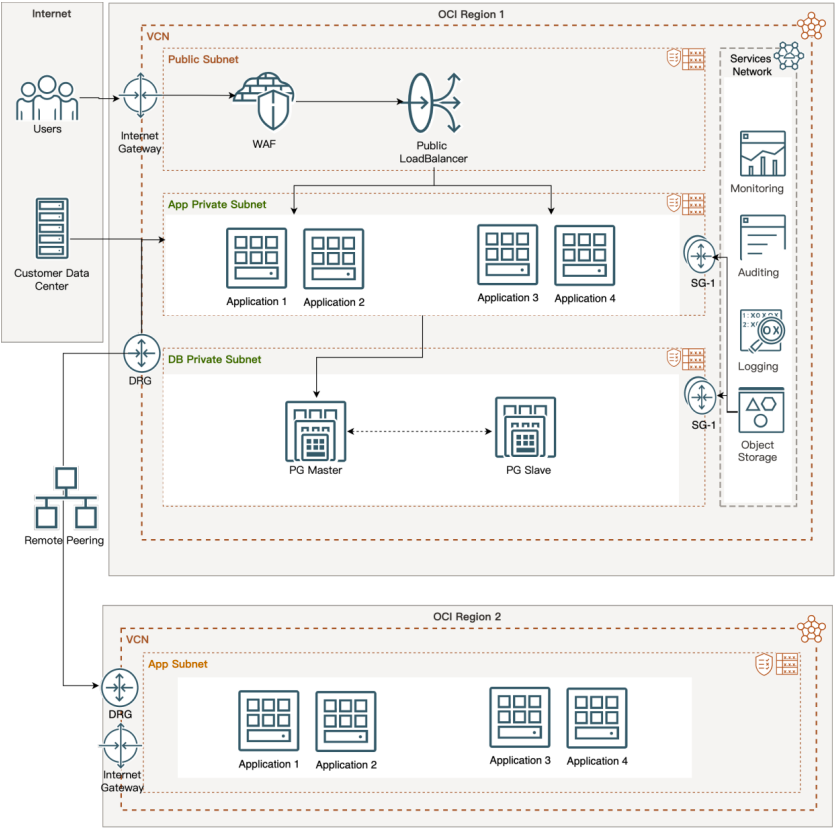
In terms of architecture, the rich basic resources of Oracle Cloud Infrastructure (OCI) are used to provide high availability, fault tolerance and scalability for the business system.
Architecture Overview
- Load Balancing serves as a unified traffic entry, intelligently distributing requests to multiple high-performance backend servers to ensure high availability and elastic scalability of applications.
- The Internet Gateway enables resources deployed in public subnets to securely access the Internet.
Security and Insight
- The Web Application Firewall (WAF) provides strong protection for Internet-facing application endpoints, effectively resisting malicious traffic and ensuring business security and policy consistency.
- Meanwhile, the Monitoring service is used for proactive observation of cloud resources, and early warnings for key indicators are set up to ensure timely notification and response when anomalies occur.
Data and Connection
- Object Storage is used to securely and reliably store massive amounts of data, which can be retrieved at high speed directly from the Internet, realizing seamless expansion of storage capacity.
- In addition, a remote peering connection is established through the Dynamic Routing Gateway (DRG) to ensure reliable and stable cross-regional data transmission; the Service Gateway enables the Virtual Cloud Network (VCN) to securely and conveniently access other platform services, connecting the network links between services.
IV. Project Process
1. Assessment and Planning
- In-depth research on business and security requirements: Collaborate closely with the client to fully understand the business scale, promotional peak traffic, core transaction processes, user data distribution and mandatory security compliance standards of its e-commerce business.
- Assessment of existing architecture and risks: Conduct a comprehensive analysis of the client’s existing IT architecture (including application servers, databases, caches, network topology and security devices), evaluate its bottlenecks, single points of failure and security vulnerabilities, and clarify the technical feasibility and optimization direction of migration to OCI.
- Design of customized solutions: Design the target architecture based on OCI services, focusing on planning multi-availability zone high-availability deployment, elastic scaling strategies, and a in-depth defense security system covering network boundaries, applications and data layers. Determine the migration method for each module. Formulate an overall security plan covering Identity and Access Management (IAM), data encryption and application protection (WAF).
2. Implementation and Deployment
- Environment setup and selection of core services: Assist the client in planning and creating networks, selecting and configuring appropriate server storage resources, and deploying and migrating to OCI’s high-availability database services and core security services.
- Application migration and integration testing: Assist the client in migration, provide technical support and cooperate in system testing.
3. Post-Delivery and Operation & Maintenance
- Switching online and support: Formulate the final business switching plan to ensure a smooth transition. Provide technical support in the early stage of going online, monitor the system status in real time, and promptly handle any problems that may arise.
- Knowledge transfer and empowerment: Provide comprehensive OCI management training for the client’s operation and maintenance team, covering resource operation, cost management, daily monitoring and incident handling.
- Continuous optimization and support: Hand over detailed architecture documents and operation and maintenance manuals. Provide continuous operation and maintenance support services, and continuously provide suggestions for performance optimization, cost optimization and security hardening based on business monitoring data.
V. Value of Cloud Migration
- By leveraging OCI’s globally distributed regions and availability zones, multi-active/disaster recovery deployment of applications and databases is realized, eliminating single points of failure. Through native load balancing and auto-scaling, the system can handle instantaneous traffic peaks during events with ease, significantly improving business continuity.
- With OCI’s high-performance computing and storage, as well as the autonomous capabilities of Autonomous Database, the efficiency of complex queries and report analysis is increased several times, providing powerful computing power for real-time recommendations and precision marketing. At the same time, on-demand elastic resource supply and refined cost management significantly improve resource utilization.
- Relying on OCI’s integrated in-depth defense system, full-stack security hardening from network boundaries, hosts and applications to data is realized. In particular, native WAF, key management and data encryption services directly protect core payment and user data assets.
VI. Client Achievements
- Extreme Experience: The average page loading time has been reduced by more than 70%, with zero interruption in order processing during promotions, and significant improvements in customer satisfaction and conversion rate.
- Agile Release: The deployment cycle for new functions and activities has been shortened from weeks to days, greatly accelerating the market response speed.
- High-Availability Architecture: Realized active-active deployment in the same city, with a Recovery Time Objective (RTO) of < 30 minutes and a Recovery Point Objective (RPO) of ≈ 0 for core businesses.
- Total Cost of Ownership (TCO) Optimization: Under the premise of ensuring higher performance and security levels, the three-year total cost of ownership of infrastructure is expected to decrease by 20-35%.