

Alibaba Cloud International Case — SPGame
Project Background
As a leading online game operator and publisher, SPGame always upholds the idea of delivering pure gaming fun to players worldwide and is committed to building premium game brands. Although key focus markets such as Taiwan, Hong Kong, Macau and South Korea are deeply cultivated, market saturation is rising and acquiring new users is getting harder. At the same time, in popular game categories such as MMO, card and idle games, many competitors keep launching new products. SPGame urgently needs to expand its overseas market footprint, precisely reach potential players, boost international brand awareness and enhance user stickiness so as to stand out in the global game market.
The existing self-built IDC architecture has obvious shortcomings. Global node coverage is insufficient and cross-border network fluctuations cause unstable player latency and lag in cross-server competition. Concurrent capacity is insufficient during event peaks. The traditional static resource allocation model has low idle-time resource utilization and cannot support the expansion of a globalized game business.
Challenges
It is not only about solving the cross-border network latency and lag problem but also about how to elastically schedule infrastructure resources and improve resource utilization
Due to large cross-border network quality fluctuations player latency is unstable and lag easily occurs in cross-server competition scenarios
Concurrent requests are high during event peaks such as new version launches
Traditional IDC resources are allocated statically and idle-time resource utilization is low
Solutions
Build a globalized game cloud architecture on the Alibaba Cloud International platform with layered traffic access and container business and data storage and observability monitoring systems
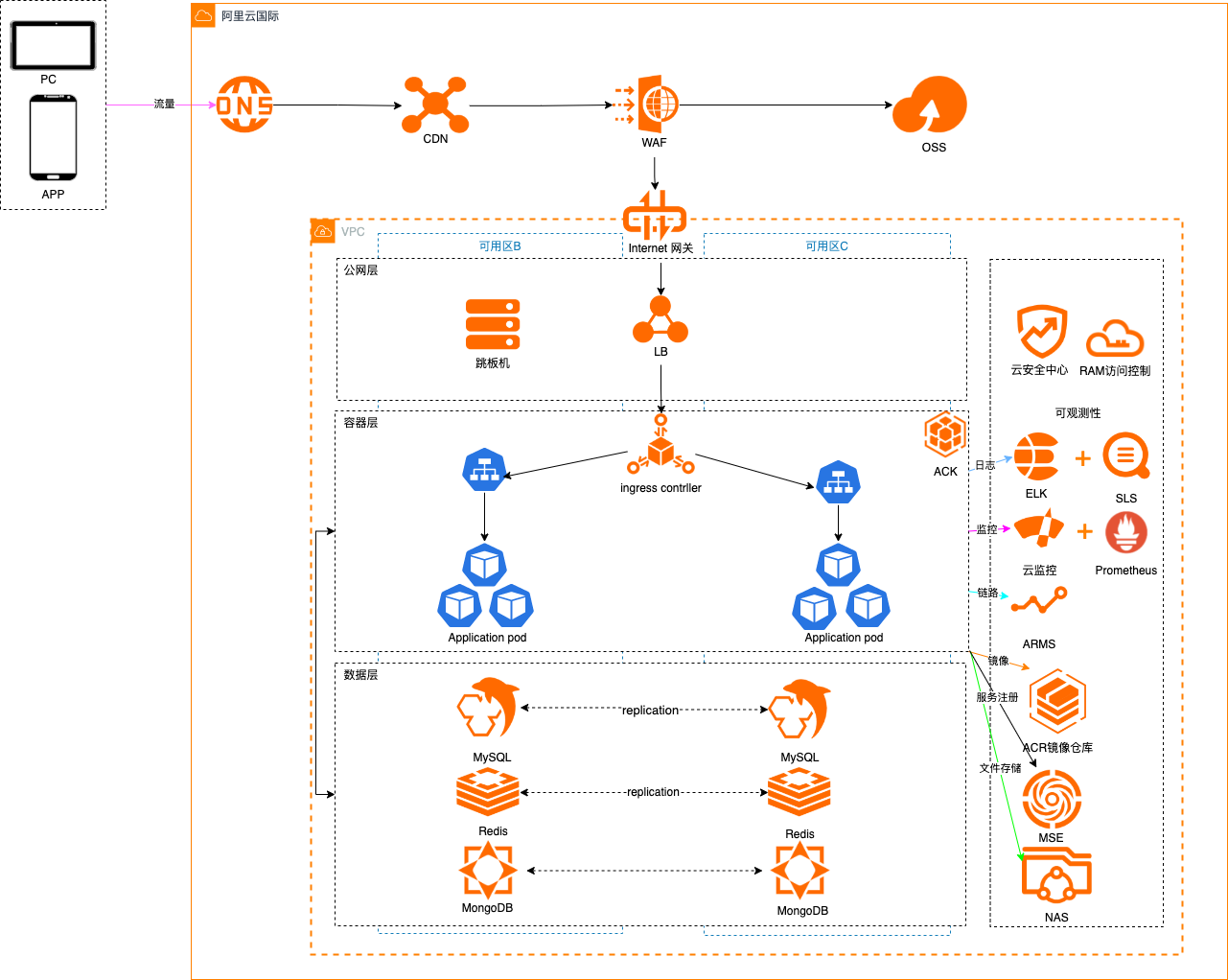
User requests complete initial routing via DNS intelligent resolution. Business traffic first passes through the CDN and is then forwarded to the WAF to filter web attacks. The WAF deeply parses HTTP/HTTPS requests and dynamically blocks threats such as SQL injection and XSS and forwards normal business traffic to the business system — ensuring business and data security.
- Use the ACK container service Kubernetes edition to manage containers. The Ingress Controller manages external traffic access to the cluster and maps it to the corresponding Application pod by URL rules. Elastic scaling policies are configured based on historical traffic prediction to achieve dynamic application scaling.
Use RDS MySQL to store relational business data and rely on master-slave replication for data redundancy backup and high availability and better read performance. Redis caches hot data to reduce database pressure and improve response speed and ensures availability through replica replication. MongoDB stores non-relational data such as player-generated content to fit diverse game storage needs.
ELK and SLS handle log collection and storage and analysis. Cloud monitoring and Prometheus collect server resource and application performance metrics. ARMS performs real-time application performance monitoring. ACR stores container images. MSE provides microservice governance capabilities.
Project Architecture
The whole deployment is on Alibaba Cloud International and is divided into traffic access layer and VPC private network layer (public network layer and container layer and data layer) and supporting capability modules
Customer Outcomes
Relying on Alibaba Cloud International global cloud nodes to build an elastic game cloud architecture it optimizes the cross-border player game experience and enables automatic business elastic scaling and higher resource utilization and lower infrastructure costs.
By working with Alibaba Cloud International and using its globally distributed cloud server nodes the issues of insufficient self-built IDC node coverage and cross-border network quality fluctuations are solved. Unstable player latency is significantly improved and lag in cross-server competition scenarios is reduced.
With the elastic scaling capability of cloud services the system can quickly respond to concurrent requests during event peaks such as new version launches. Game crashes or lag caused by insufficient server capacity are reduced. Bad player experiences caused by service interruptions are effectively avoided and player churn is reduced.
Say goodbye to the traditional static IDC resource allocation model. After adopting a dynamic resource allocation strategy idle-time resource utilization is improved and server operating costs are reduced